Showing posts with label Research. Show all posts
Showing posts with label Research. Show all posts
Thursday, 3 November 2016

Thursday, 20 October 2016
Opening Credits Analysis

1. What have out found out from doing this activity.
From this activity I have discovered that the opening credits are not as in-depth as the final credits, but they feature the main people in the production company etc. and the main cast.
2. Has anything surprised you?
I found that when timing the length of each name for example, it was a lot longer than I had thought.
3. What do you notice about the style/font of the titles? How does this communicate the genre?
The font was yellow and quite bold on the screen which went well with the scene of the men in suits as they look brave and like real criminals, which contrasts the previous scene in the diner.
4. What are the titles you will need to include in your opening sequence?
In my opening sequence I will need to put in the main actors, the screenplay writers, the production company, the directors and the title of the film.
Friday, 7 October 2016
Sin City Opening Sequence Analysis
Sin City is a crime action/drama film released on the 1st of April 2005 by Dimension Films and Troublemaker Studios. It was directed by Quentin Tarantino, Frank Miller and Robert Rodriguez. This film had a target audience of adults ageing between 18-35, this is because this type of audience would be comfortable with the high level of violence throughout the film. In terms of social economic class, this film would probably appeal mostly to classes of C downwards, such as students as they are looking for excitement which is attained through the films exaggerated themes.
Narrative
Although we can not tell this from the opening sequence, Sin City is an example of non-linear narrative. Unfortunately, character types and binary oppositions are hard to identify in the opening sequence of Sin City as it is all a bit confusing, this however is good in some way as it gives way for some of the enigma codes such: "Who is the man in black and the woman in red?" "Why is the woman in red?" "Why does the man shoot the woman?" "Why does the film start like this and what relevance does it have to the rest of the film?". These questions all hook the audience and make them want to continue watching to find out the answers.
Media Language

The opening scene has very low key lighting and the use of shadows in this neo-noir scene grip the audience. We can hear the non-diegetic sounds of cars and police sirens throughout the scene, we can only see certain diegetic soundssuch as the characters footsteps and voices, the lighting of the woman's cigarette, the rain while they are kissing and the gun being fired. First of all we have a long establishing shot of the woman on the balcony with the buildings towering over her to show her insignificance.
 We then see another shadowy figure come out from behind the woman and start coming towards her. The fact that the characters face is shadowed, suggests his moral ambiguity to the audience, and the fact that the woman is stood there holding herself shows her loneliness and vulnerability to the audience.

We then have a close up shot of the two characters hand as the man offers the woman a cigarette, which sows his power and that he is in control.

Next we have a close up of the woman's face as the man lights her cigarette for her, her eyes turn green which could suggest that the woman is hiding something and that there is more to her than what we first see.
 We then have an over the shoulder shot from the point of view of the man which is coordinated to make him seem much taller than the woman which again implies his power in the scene. He is also partially shadowed which suggests something sinister and foreshadows the killing of the woman.
 Lastly, we have a crane shot of the two character as the male holds the dead woman's body after he has shot her, he is looking up to the sky, almost as if he is asking for redemption after the murder.
Thursday, 29 September 2016
Reservoir dogs opening sequence analysis
 Reservoir dogs is a cult classic directed by Quentin Tarantino, released on October 23rd 1992. It was produced by Artisan Entertainment (formerly known as LIVE Entertainment) and Dog Eat Dog Productions. Reservoir dogs is a crime drama/thriller which had a target of 18-40 year old males, it starred: Quentin Tarantino, Harvey Keitel, Michael Madsen, Chris Penn, Steve Buscemi, Lawrence Tierney, Eddie Bunker and Tim Roth.
Narrative
Reservoir dogs has a non-linear narrative but we do not see this in the opening sequence, throughout the film the films skips to before and after the robbery, through a series of flashbacks, while we never see the heist itself. As for character types, Propp's theory can not be applied so easily in Reservoir Dogs as in other films because the film does not focus solely on one characters goals and motives so it is hard to determine who the 'hero','donor' and other character types. Usually in a classic Hollywood narrative film, the 'hero' accomplishes his goal but in Reservoir Dogs, nobody achieves what they set out to do. Binary oppositions are also tricky to identify in this film as unlike classic films, Reservoir Dogs does not really let us judge the characters into specific groups. We could say that there is a a simple 'good v evil' element in the film but at the same time, following the criminals story makes it hard to judge whether they are overtly 'good' or 'evil'. Some examples of the enigma codes present in the opening sequence are: Why does Mr.Pink not want to tip? Where do they go after the diner? What happened to the bleeding character? This gives a mysterious edge to the film and makes the audience want to continue watching and find out the questions which they are asking.
Media Language
 Everyone at the table apart from the characters of 'Nice Guy Eddie Cabot' and 'Joe Cabot' are dressed in suits, while sitting in a diner. They are sitting, drinking their coffee with empty plates in front of them and a couple of them are smoking. The diegetic sound of the characters speaking is clear throughout the opening sequence, but non-diegetic sounds that can be heard as well. We can hear the chatter of the other people in the diner, there is music playing in the background which is to add to the diner mood, we can hear the clatter of cutlery and plates to further add to the atmosphere, while we do not see these things, we do see some random people standing and sitting in the diner but the camera never focuses on them. The camera stays at about the same height as the characters shoulders while circling the table throughout the opening sequence, the camera is steadier when coming to a more important character in the film and stays on him for longer, while being shakier on less important characters and not staying on them for longer. This seems to foreshadow the significance of the characters in the film. There is low key lighting throughout the opening sequence which sets the mood and makes the scene more chilled out and relaxed like the characters at the table.
Representation
The most interesting thing about this opening sequence is that Tarantino is trying to portray a group of criminals. This is a very subversive representation of what we believe criminals to act like, as here we see an ordinary looking group of men in a diner, having a natural free-flowing discussion. We wouldn't associate these topics such as Madonna's "Like a virgin" with a group of criminals and it all seems a bit too calm for a heist movie. This representation relates to the target audience as the criminals are portrayed as normal people having a normal conversation, meaning that the audience can connect with the characters on the same level.Sunday, 25 September 2016
Saturday, 10 September 2016
Tuesday, 6 September 2016
Monday, 5 September 2016
Camera Framing & Movement
Camera Framing and Movement
Frames
- Extreme Close Up

(http://waltongoodfellowr.blogspot.co.uk/2009/11/camera-shots-angles-and-movement.html)
- Big Close Up
 A big close up shot is a magnified shot which focuses on a bigger area than an extreme close up. For example, a big close up shot of a person will include the eyes and mouth, but not the whole head. This type of frame can be used by a director to focus on a persons facial features; or to draw the viewers attention to a specific object to make the viewer feel empathy; or to add a sense of mystery. Big close up is often abbreviated to BCU on a script, storyboard or shotlist.
(http://eyefish.tv/dictionary/big-close-up)
- Close Up

A close up shot will show little background and focuses mainly on either a face, or a specific detail of the scene, with the background blurred. When using a close up shot of a subject's face, the director will draw the attention of the audience to the face while showing the shoulders and may often leave a bit of head room at the top of the frame. This type of shot is the most common as it can convey a lot of emotion and help the director to create a real sense of empathy towards the subject. Close Up is often abbreviated to CU.
(https://elmercqegs.wordpress.com/2011/03/18/camera-shots-and-movement/)
(https://elmercqegs.wordpress.com/2011/03/18/camera-shots-and-movement/)
- Mid Shot

A mid shot, or medium shot, usually shows a character from the waist up, or shows the important areas of an object significant to the scene. This type of shot is usually used when a subject is speaking or delivering information, it is also used a lot to show a character's arm gestures while they speak. A mid shot will usually cut out some of the background, allowing the viewers concentration to be on the body language and dialogue as a reaction shot will often draw the audience in. This type of shot allows the audience to clearly see the objects details, or the characters' expressions and movements, while not allowing them to dominate the scene. The problem with this is that it can often show too much of the background, if the background is too dynamic, this can be a distraction.
- Mid Long Shot
 A mid long shot or medium long shot is also sometimes known as the three quarters shot, this is because it shows the subject from the knees up. This is an intermediate shot between the mid shot and the long shot. The shot shows the whole subject in relation to its surroundings, often to give the audience an insight to the subjects size.
 - Long Shot

Long shots are used to show a full character, or a feature object as part of the landscape, this often helps us to establish a connection between the object or person and the surroundings. These shots have the point of focus still as the object or person while showing a lot more of the background. They are often used to show action and movements, rather than emotion.
(http://1.bp.blogspot.com/_lXHRxMktlc8/TJj0Y0ArerI/)
- Extreme Long Shot

An extreme long shot covers a wide area to set the scene, this is why it is often called an establishing shot. The shot can be used to establish the time, weather and location. This type of shot is often used in disaster filming to show the destruction and provide the audience with an element of thrill.
(http://bluefish0.weebly.com/blog/camera-shots-angles-and-movement)
- Point of View Shot

(cherrycadaver.wordpress.com)
- Worm's Eye View
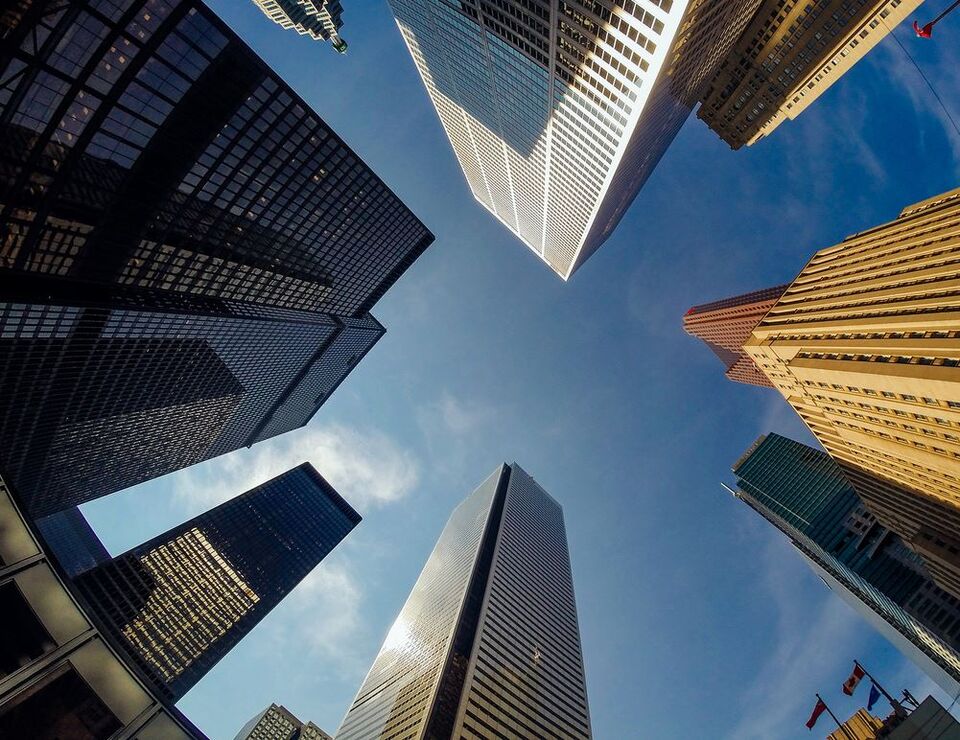 A worms eye view shot is a view of an object from below, as though the observer were a worm, the opposite of a bird's eye view. This type of shot is used to make an object look tall, strong and powerful. This frame is often used to show the view that a child or pet would have.
(http://xn--80aalewbjz9aa3im.xn--p1ai/worms-eye.php)
- Bird's Eye View

A birds eye view is a shot taken from directly above the scene. This type of shot is often used to establish the landscape and the character or objects relationship to it. A birds eye view can usually make people seem insignificant, ant-like and part of a bigger plan.
(http://www.videoeditingsage.com/Overhead-shot-camera-angle.html)
- Aerial
 An aerial shot is taken from above, usually from something like a helicopter, and is similar to a crane shot. They are usually used to establish the scene with movement.
- Crane

A crane shot is a shot taken by a camera on a crane or a jib. The crane shot is used to view the actors from above and to move up and away, this is commonly used to end movies by moving away from the characters or scene,
(https://revision4gcses.wordpress.com/media-studies/camera-anglesmovementshots/)
- High Angle

- Low Angle
 In low angle shots, the camera looks up to the subject and makes them look larger and more imposing. These are useful for increasing the height of an actor and also giving a sense of sped up motion. Low angles can also give the viewer a sense of powerlessness compared to the height of the surroundings.
Camera Movements
- Pan
Panning involves a movement of scanning a scene/landscape from side to side (or vice versa). The camera stays still to the left and right of the subject. It can be used to show how the surroundings affect the subject, or to show whatever the subject is looking at. The camera is mounted on a tripod, which provides a stable axis point for the sweeping motion of the camera to be free.
- Tracking
Tracking, also known as dollying, is where both the camera and tripod are mounted on a moving vehicle, allowing for smooth movements following the action, generally following a character or object. This type of shot is good for moving from a mid shot to close up, gradually focusing the audience on a particular object or character, often used to show a moment of realisation.
- Tilting
This is where the tripod remains stationary and the camera tilts up and down. This movement is similar to panning but with an alteration in direction. It can be used to create a sense of unease in the character, or show surroundings, to create suspense or mystery.
- Pull Focus
The pull focus, also known as rack focus, is a camera technique in which you change focus during a shot, usually a shot of two subjects at different distances from the camera. This creates a shifting of emphasis from one subject to another.
- Zoom In/Out
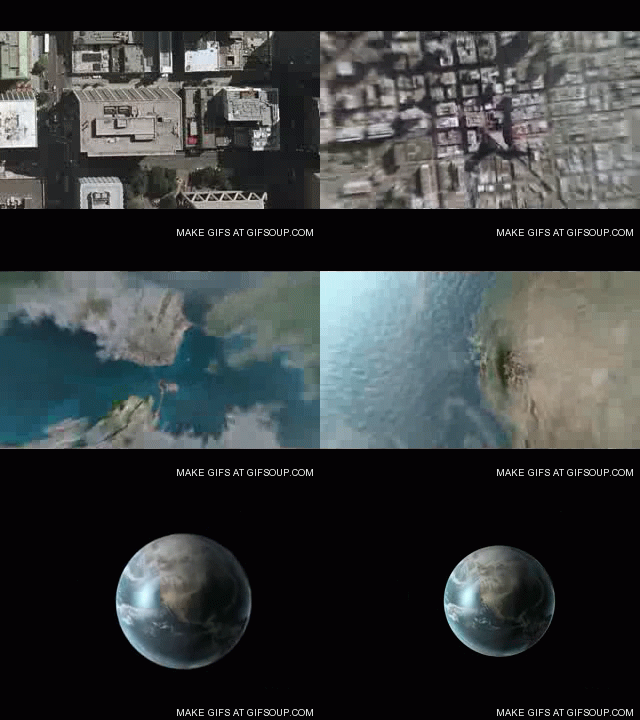 Zooming in and out is a technique used in filming which is done by changing the focal length of a zoom lens. This allows for the subject to move closer or further away from the viewer, which is useful for creating moments of suspense or realisation.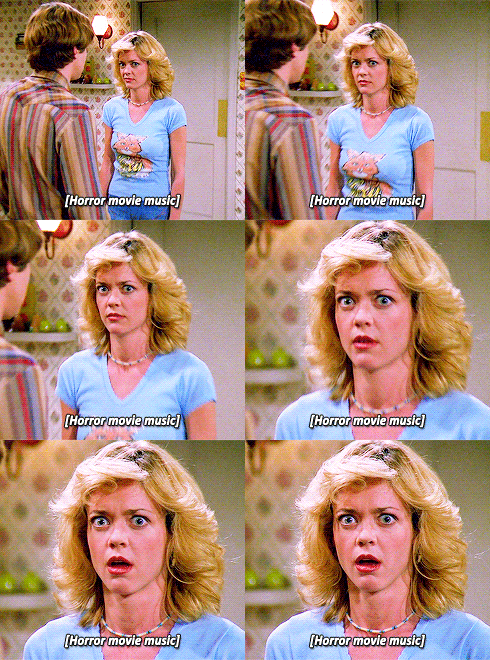
- Whip Pan
A whip pan follows the same rules as a normal pan, in which the camera moves from side to side, however the whip pan involves a quicker movement that may momentarily blur the image. A whip pan often happens abruptly and can imply a rapid unfolding of events.
- Handheld Camera

Handheld cameras are just a normal filming camera with someone holding it, instead of using support from machines such as cranes and dollys. A handheld camera can often draw a viewer in by making the audience feel as if they are in the scene themselves, rather than in a still position.
- Dolly
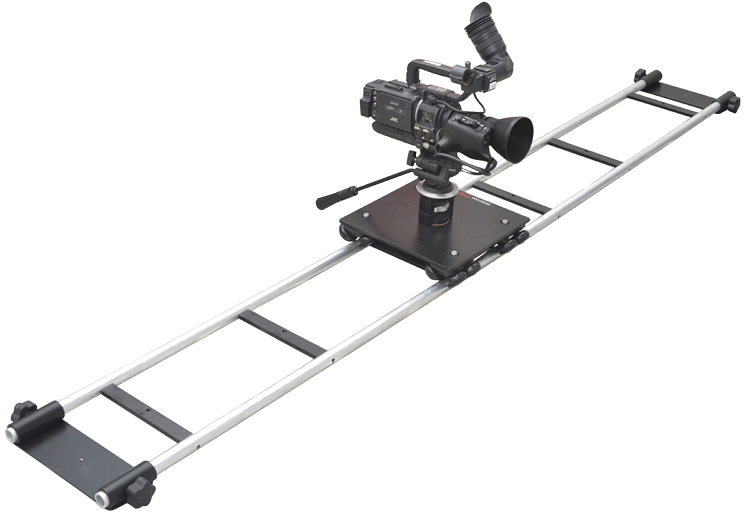

 This is the moving platform which is used to film a dolly or tracking shot. They are just moving platforms with the camera and tripod attached, they come in a huge range of sizes.
- Steadicam
 The steadicam is a heavy contraption which attaches a camera to an operator using a harness, the camera is stabilised so that it moves independently. It is used to film smoothly with a handheld camera.
Subscribe to:
Posts (Atom)